

Tradition, Political Brokerage and the Battle for Democratic Legitimacy in Garissa
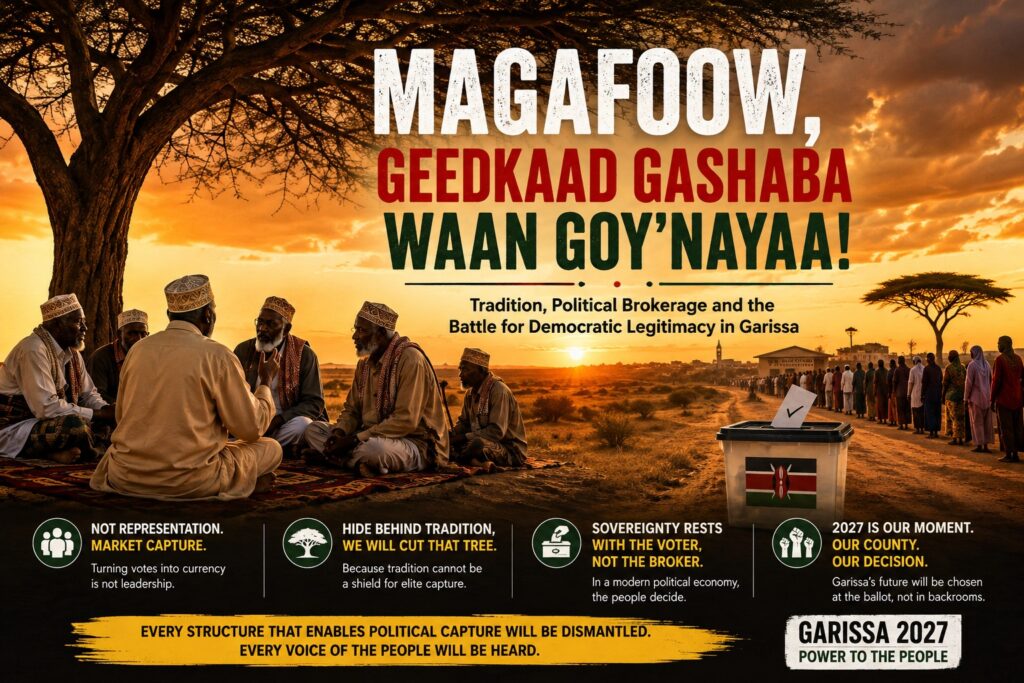
There was a time when the Council of Elders represented the moral centre of the clan a respected institution where disputes were resolved, consensus was forged and the collective interests of the community were safeguarded. Their authority rested on trust, wisdom and service.
Today, as Garissa’s political landscape evolves ahead of the 2027 General Election, that traditional role has become the subject of increasing public debate.
The concern being raised is no longer simply about cultural leadership. It is about the alleged transformation of traditional authority into political brokerage.
A growing section of the public argues that a small circle of influential actors, operating under the banner of tradition, is attempting to convert communal political influence into a negotiable political asset. In this view, votes become currency, candidates become transactions and the democratic will of citizens becomes a commodity exchanged through elite negotiations.
This is not representation. It is political capture.
Within public discourse, a new label has emerged for those perceived to play this intermediary role: “Magafayaal.”
The term reflects a perception that some individuals have positioned themselves as gatekeepers of political opportunity controlling access to endorsements, negotiating political outcomes behind closed doors and shaping electoral competition before citizens have had the opportunity to express their preferences.
Whether this perception is entirely accurate or not, its growing popularity reveals a significant shift in public sentiment. Increasingly, citizens are questioning systems of political mediation that appear to prioritise elite bargaining over open democratic competition.
That growing frustration is captured in a powerful Somali expression:
“Magafoow, geedkaad gashaba waan goy’nayaa.”
Hide behind whichever tree you choose we will cut it down.
In political terms, the message is unmistakable.
Hide behind tradition and citizens will challenge the misuse of cultural authority for political ends.
Hide behind calls for unity and they will question whether that unity reflects genuine public consent or merely agreement among political elites.
Hide behind closed-door endorsements and they will demand transparency.
Hide behind the declaration that “the elders have spoken,” and they will insist that, in a constitutional democracy, the final decision belongs to voters.
The emerging debate in Garissa is therefore larger than any individual politician or elder. It reflects a contest between two competing models of political legitimacy.
The first is rooted in democratic participation, where authority flows from the people upward. Leadership is earned through ideas, public trust, performance and accountability.
The second is rooted in negotiated elite consensus, where political influence is concentrated within a small network that seeks to shape outcomes before the electorate is consulted.
One model strengthens democratic institutions.
The other risks weakening them by shifting political decision-making away from citizens and towards informal centres of influence.
Respect for elders remains an important pillar of Somali society and continues to deserve recognition. However, respect and political legitimacy are not identical concepts.
In a devolved constitutional system where county governments manage significant public resources, budgets and development priorities political legitimacy must ultimately derive from the informed and voluntary consent of the electorate.
When any public figure, regardless of status, is perceived to move from safeguarding community interests to negotiating political outcomes for particular interests, public confidence inevitably comes under scrutiny.
This explains why the accusation of being a magafe resonates with many citizens. It reflects a broader concern that institutions historically established to protect communal interests may, if not carefully safeguarded, become mechanisms through which political power is concentrated rather than democratically distributed.
Yet Garissa itself is changing.
A younger, more informed and increasingly independent electorate is reshaping the political conversation.
For many voters today:
- Votes are not livestock to be negotiated.
- Leadership is not a private contract between elites.
- Public office is not an asset to be allocated among a privileged few.
County leadership belongs to the people.
Its future cannot be negotiated in private and merely announced in public.
That is why the phrase “Magafoow, geedkaad gashaba waan goy’nayaa” has evolved beyond a slogan. It has become a political statement about accountability, transparency and democratic ownership.
Its underlying message is clear: every structure perceived to enable political capture will increasingly face public scrutiny. Every informal network that substitutes elite negotiation for citizen participation will be questioned. Every attempt to convert public political power into private political capital will encounter growing resistance.
As Garissa approaches the 2027 elections, the central political question is no longer simply who will lead the county.
It is whether political authority will continue to be negotiated on behalf of citizens or exercised directly by them through the ballot.
In the end, the legitimacy of leadership will not be determined by closed-door consensus, inherited influence or negotiated endorsements.
It will be determined by the freely expressed will of the people.